Law Enforcement Accountability

Police have the vital and difficult job of protecting public safety. Performing this job effectively does not require sacrificing civil liberties or civil rights. All Oregon police agencies, from the state patrol to city police forces, need to respect the rights of individuals while enforcing the law.

Police car on a city street

“If the government becomes a law-breaker, it breeds contempt for law; it invites every man to become a law unto himself; it invites anarchy.”
— Louis Brandeis,
U.S. Supreme Court Justice,
Olmstead v. United States (1928)

Police have the vital and difficult job of protecting public safety. Performing this job effectively does not require sacrificing civil liberties or civil rights. All Oregon police agencies, from the state patrol to city police forces, need to respect the rights of individuals while enforcing the law. And when misconduct occurs, there must be policies and mechanisms for holding police accountable for their actions.

ACLU is also working to eliminate racial and ethnic profiling in police practices that have a disproportionate impact on individuals merely because of their race, color, national origin or religion.

The Latest


Press Release
DSPDX v ODOJ collage

ACLU of Oregon Petitions Attorney General on Behalf of Don’t Shoot Portland for Public Records

The ACLU of Oregon and Don’t Shoot Portland are petitioning the Oregon Attorney General to review the Oregon Department of Justice (ODOJ)’s refusal to disclose public records relating to the Oregon TITAN Fusion Center (OTFC).
Resource
A line of police in riot gear

Portland Police Public Records Project

Highlights and potential violations of Oregon’s privacy laws that emerged from the public records we obtained from the Portland Police
Know Your Rights
black and white military troops

Encountering Law Enforcement and Military Troops in Oregon

Press Release
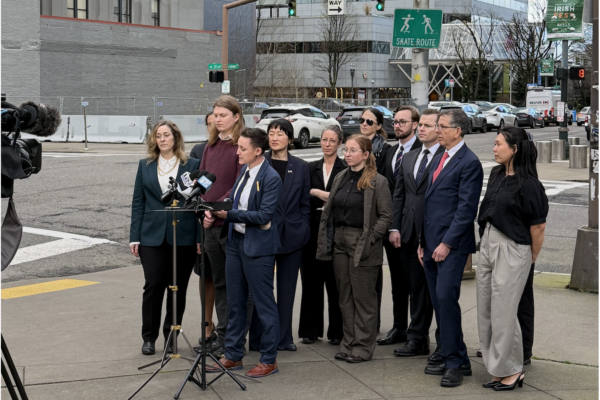
Press Conference March 4 2026

ACLU of Oregon Wins Provisional Class Certification and Preliminary Injunction to Stop DHS Officers from Retaliating Against Nonviolent Protesters and Journalists at Portland ICE Building

Federal District Court Judge Michael Simon ruled in favor of Plaintiffs, protesters and journalists, issuing a Preliminary Injunction to protect nonviolent protest and reporting at the Portland ICE Building.

Cases, Campaigns & Legislation


Court Case
Oct 19, 2026

Don’t Shoot Portland v. Oregon Department of Justice

Don’t Shoot Portland and ACLU of Oregon are two Oregon nonprofits dedicated to advocating for racial justice, police accountability, and the right to protest. In 2024, both organizations submitted public records requests to illuminate how Oregon TITAN Fusion Center (OFTC) works with other law enforcement agencies to monitor and surveil Oregonians engaged in lawful advocacy and protest — including for racial justice. The OTFC is a federally funded domestic surveillance program housed under the Oregon Department of Justice’s Criminal Intelligence Unit that works closely with federal law enforcement agencies like the increasingly notorious Department of Homeland Security (DHS). The OTFC operates as part of a vast nationwide network of about 80 similar fusion center programs nationwide. For two decades, OTFC has operated with little oversight or transparency while purporting to collect, analyze, and disseminate information about “terrorism” and crime in Oregon. However, the OTFC, like other fusion centers across the country, has a checkered history of abuses. ODOJ withheld nearly 2000 records from its response — largely the ones it said the ACLU would be “most interested in” — based on its “Third Agency Rule,” which it said requires OTFC to keep records it receives from other agencies confidential. The Petition argues that rule cannot displace ODOJ’s obligations under the Public Records Law. The disputed records include “Criminal Intelligence Unit Bulletin[s]” issued by the Portland Police Bureau that name Don’t Shoot Portland (sometimes referred to as Don’t Shoot PDX) and “Criminal Intelligence Unit Protest [and] Significant Event Information Briefs” that name Sean Kealiher, a founding organizer of Don’t Shoot PDX’s community action plan who was killed in 2019 at age 23. The existence of the records suggests additional evidence of OTFC’s improper surveillance of people and groups engaged in protected political and noncriminal activities. Plaintiffs urge the Attorney General to reject ODOJ’s reliance on the Third Agency Rule as blanket authority to withhold records from the public. The people of Oregon deserve transparency about how state, local, and federal police cooperation affects their rights and freedoms.
Legislation
Feb 3, 2026

HB 4138: Law Enforcement Accountability and Visibility Act

Status: Passed both chambers
Position: Support
Campaign
Mar 2026

2026 Legislative Session

The ACLU of Oregon’s 2026 Legislative Session Priorities
Court Case
Oct 20, 2025

May v. City of Eugene

The ACLU of Oregon and our legal partners, Visible Law and LeDuc Montgomery LLC, filed to sue the City of Eugene for failing to disclose public records pertaining to the city’s operation of Flock Safety cameras. This lawsuit is filed on behalf of Seth May, a member of Eyes Off Eugene, a group of advocates and technology professionals who are rejecting mass surveillance in Oregon through public education and organized advocacy. Flock cameras are a type of advanced surveillance technology that presents a significant threat to privacy by tracking the movements of every vehicle (and even images of pedestrians, bicyclists, and animals), without a warrant, suspicion, or consent from the public. Flock allows for this personal data to be uploaded to an AI-powered platform that can be accessed by law enforcement and private companies across the country, with little to no regulation. Learn more about Flock’s disturbing web of surveillance and data sharing on our Know Your Tech Flock page. By denying Mr. May’s request and refusing to disclose the requested records, the City violated Oregon public records law. The City of Eugene’s refusal to disclose the records despite the significant public interest in them stands in stark contrast to the transparency that other cities like Springfield, Medford, and Woodburn have provided the public by identifying the locations of Flock cameras without issue. The ACLU of Oregon and our legal partners are representing Mr. May and suing the City of Eugene to ensure that the City of Eugene cannot hide their actions while demanding the public live their lives under the unblinking eyes of Flock.